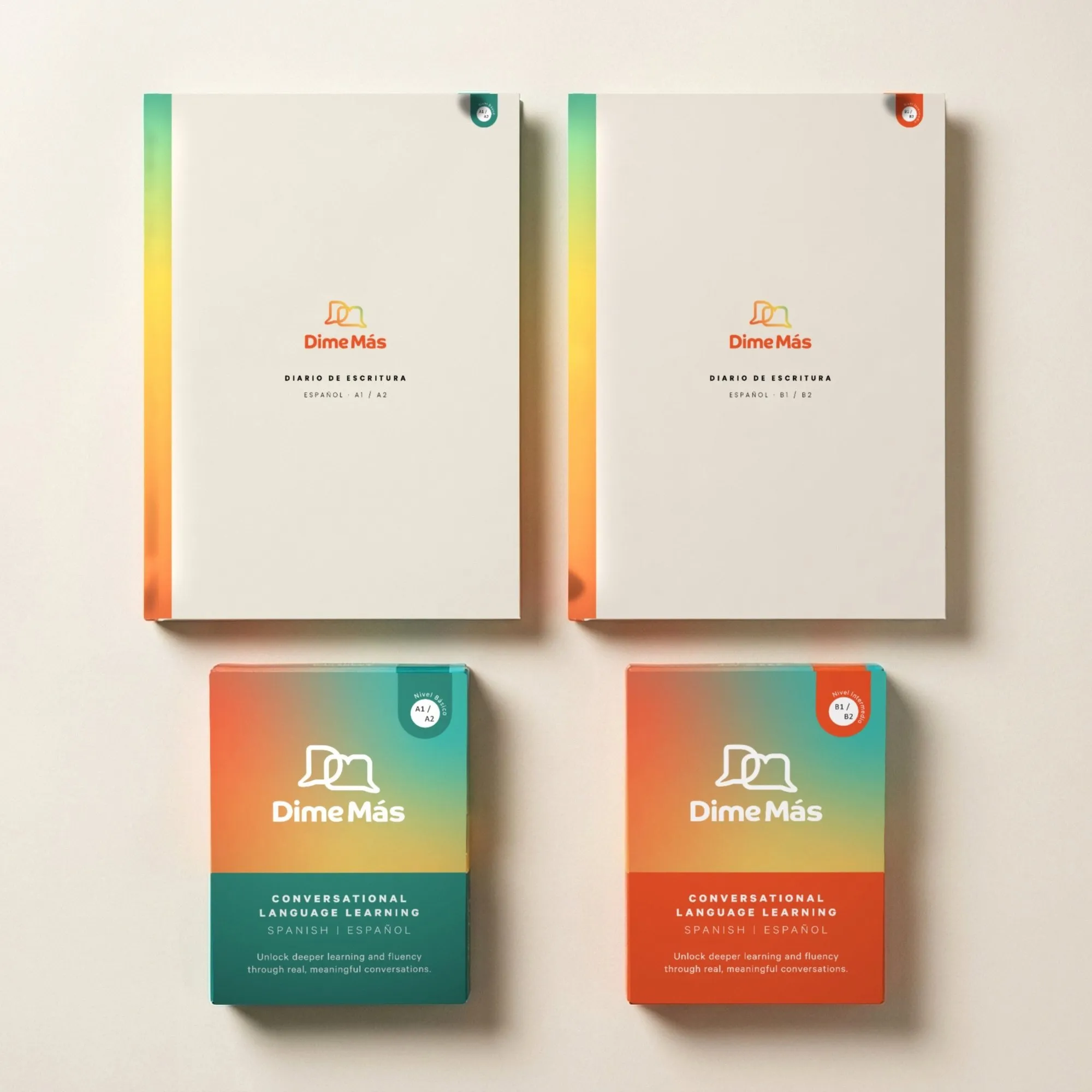
A1, A2, B1 and B2 are levels from the Common European Framework of Reference for Languages, usually shortened to CEFR. It’s published by the Council of Europe, and it describes what you can do with a language rather than how many words you know. That’s why B1 means much the same thing in a class in Madrid as it does in Manchester.
This guide puts the first four levels into everyday terms for conversation: what you can talk about at each one, how to tell where you are, and which Dime Más cards fit. It isn’t a test. Think of it as a map.
A1
Breakthrough · basic user
What is A1 Spanish?
A1 is your first footing in Spanish. You can say who you are and where you live, ask someone the same, and understand everyday words and very simple phrases. It works best when the other person speaks slowly and is happy to help.
What you can talk aboutYour name, where you’re from, your family, your home, what you like to eat.
At A2 you can handle simple, routine exchanges. You can describe your background, your town and what you need in short sentences. You follow the phrases that come up again and again, and you can keep a short chat going while the subject stays familiar.
What you can talk aboutYour week, your job or studies, your neighbourhood, shopping, plans for the weekend.
B1 is where Spanish starts to feel like yours. You can follow the main points when people speak clearly about familiar things, and get by in most situations on a trip. You can tell the story of something that happened, talk about hopes and plans, and give a reason for what you think.
What you can talk aboutA trip that went wrong, a decision you made, what you would miss if you moved, why you chose your work.
Example question
¿Qué echarías de menos si te mudaras a otro país?
What would you miss most if you moved to another country?
At B2 you can hold a normal conversation with native speakers without either of you working too hard. You follow the main ideas of more complex talk, including abstract topics. You can explain your view on something in the news and weigh up the pros and cons.
What you can talk aboutValues, change, identity, fairness at work, the news, what home means to you.
Example question
¿Te sientes una persona distinta cuando hablas otro idioma? ¿Por qué?
Do you feel like a different person when you speak another language? Why?
Read these four questions in order and stop at the first honest no. Your last yes is a good guide to your speaking level.
A1Can you introduce yourself and answer simple questions about your home and family, if the other person is patient?
A2Can you chat about your week, your work or your town in short sentences, and keep it going for a few turns?
B1Can you tell a story about something that happened to you, and say why you think what you think?
B2Can you keep up with a conversation at normal speed, and argue both sides of something you care about?
Understanding often runs ahead of speaking. If you follow far more than you can say, go by what you can say. And if two people at the table sit at different levels, that’s fine. The stronger speaker answers more fully, and the English beside each question keeps everyone in the conversation.
Which Dime Más cards suit your level?
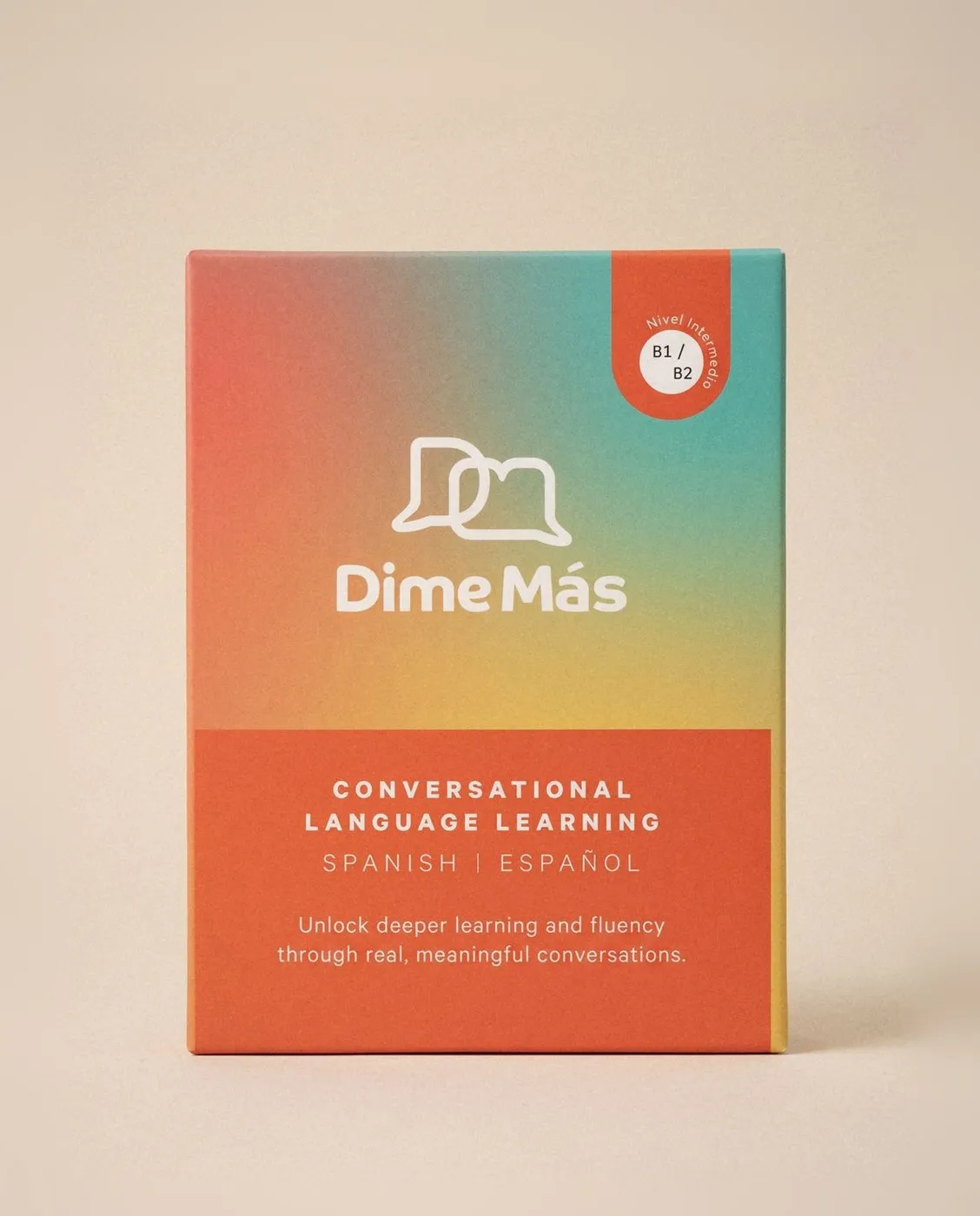
B1/B2Available now
Intermediate cards, B1–B2
For B1 and B2, and for A2 learners ready for the next step. Sixty open questions in Spain Spanish, with English on every card, so you can reach a little further without getting stuck.
The levels on this page come from the Common European Framework of Reference for Languages (CEFR), published by the Council of Europe. The descriptions above are our own everyday reading of the CEFR global scale for A1 to B2, written to help you choose conversation cards. They are not an official assessment.
Above B2 sit C1 and C2, the proficient user levels. This guide stops at B2 because that’s where Dime Más stops.